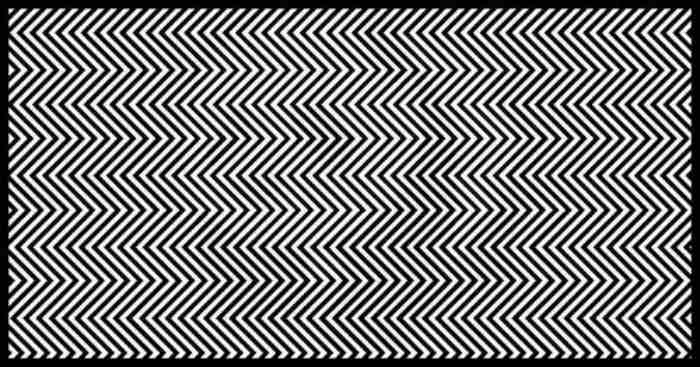
Studies Say Only 1% Of People Can Find The Animal In This Picture. Can You?

There’s an image that has recently gone viral because apparently, only 1% of people can find the animal in this picture. Can you

Well, our brains are definitely hurting now so we might have to come back to that one later.

Ready for Round Two?
Ever heard of the McCollough effect? It’s this weird trick of the mind where, after staring at a colored grating (alternating lines), your brain starts to see a pinkish tinge or other colors when looking at black-and-white lines.

It’s said that to trigger the effect, you simply stare at the center of two colored “induction images” for several minutes or more, switching back and forth repeatedly. It works best with green or red lines. Then, when you look at vertical black-and-white lines, you’ll find it appears red, green, or pinkish in places.

Tilting your head 90 degrees may lessen or enhance it. In fact, rotating the induction images and staring at them again may actually reverse the effect. The longer you stare at the original induction images, the longer it’ll last – for hours, days, or even a few months in some cases.
But is that actually true, and what’s causing it if so?

The effect is named after its discoverer, US psychologist Celeste McCollough Howard. She was the first person to ever find a so-called “contingent aftereffect”, which is an illusion that affects your brain for an extended period of time.

Over the years, there have been a number of studies done on the effect. Back in 1975, two researchers tested five groups of 16 people and, amazingly, one of the groups showed no lessening of the effect after five days. In fact, the effect remained better than half strength for four groups up to 2,040 hours later – or almost three months.

You can test the effect for yourself, with the images below. Note, there is a chance it can affect your vision for a while – although it only really gets triggered when you see vertical or horizontal lines afterwards. For the most part, it appears to be harmless. Up to you.

So, what’s causing it? Well, there has been some debate about that. There are three main lines of thought, one being that is has something to do with neurons in your visual cortex. Another is that your brain tries to color-correct the world and gets a bit stuck, while a third is that it’s a sort of withdrawal symptom, in this case an absence of color.

There was a particularly interesting study done on it back in 1995. Researchers then examined a single patient, one who had experienced significant brain damage. According to the researchers, he was “able to see color but little else”.

After showing him red-and-green gratings (although he was not really able to notice the gratings), the patient still reported that the effect worked when using a black-and-white grating after. The researchers concluded that the effect thus was probably occurring within the visual cortex, or somewhere between the eye and the brain.
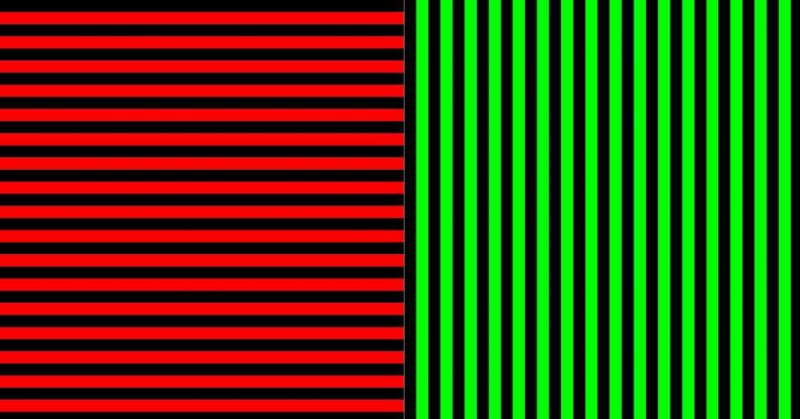
These are the two induction images that can trigger the effect, if you alternate between staring at their centers for a few minutes. Fredifortakeoff/Wikimedia
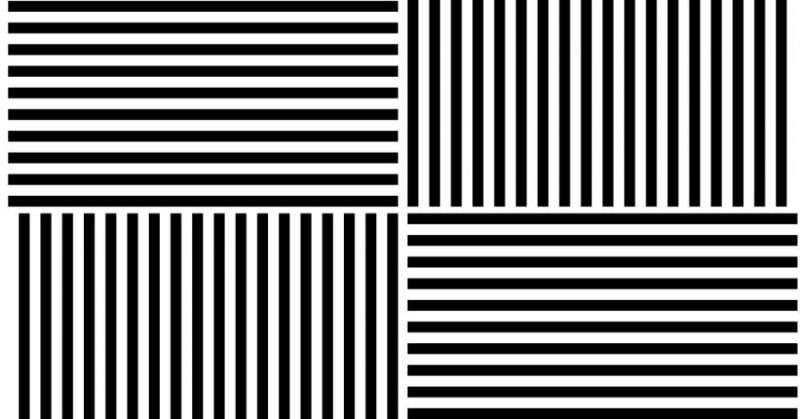
Then if you look at this image, it should appear red or green in parts, or even pinkish. Android Mouse/Wikimedia

A thesis submitted by Julien Ciroux to Edinburgh University agreed with this. He wrote that “the processing mechanisms involved in the ME [McCollough effect] are mostly located in the primary visual cortex, even if the change in this early area of the visual system drives subsequent modification in the activity pattern of higher cortical areas.”

Some studies have looked into just how prevalent the effect is. One way back in 1969 found that various stripes colored red and green produced the after-effects. Weirdly, it found that if your induction image was green, then you’d see red colors on vertical grates and green colors on horizontal grates. If a red induction image was used, then those colors reversed.

What’s weirder, it was only green and red that worked. “Colors near pure blue and pure yellow, which had little red or green content, produced weak aftereffects,” the study noted.. As far as we can tell, there isn’t a good explanation for why red and green are so good at producing the effect compared to others.

As for the grating thing? Well, that might be due to neurons in your visual cortex responding more strongly to their “preferred orientation and spatial frequency,” according to another study. It even suggested a rather interesting theory, that the JPEG image format used “plaid-like” (chequered) patterns, which are basically two gratings overlaid on each other.

“Perhaps the efficiency of this kind of representation means that something similar is also used by the visual system?” they wrote.

And that’s kind of where we are now. It looks very much like the visual cortex is doing something, with your brain being tricked in one way or another. The exact mechanics behind it, though, are not completely understood. However, it does look like it’s very much a trick of the brain, and not a problem with our eyes themselves.

It’s also a good reminder that our brains are easily fooled, such as struggling to tell lines are parallel or being confused by concentric circles. Brains are weird, huh?

Related articles

AT. Elon Musk Explodes: ‘The EU Must Be Abolished’ After X Slapped With €120M Fine

Billionaire lashes out at officials after social media platform X incurred €120m fine for transparency breaches Elon Musk has escalated his war of words with Brussels, declaring…

Elon Musk drops a BOMBSHELL: A fully solar-powered car is officially coming in early 2026 — no longer a rumor!”

The global tech world is spiraling into chaos after Elon Musk finally confirmed what had been whispered in secret labs for years: A revolutionary car powered entirely by SUNLIGHT is real…

ELON MUSK SHOCKS THE WORLD: TESLA TESTS “NANNY-BOT” — A CHILD-CARING ROBOT THAT PLAYS, SUPERVISES, STUDIES, AND EVEN PLAYS PIANO WITH HIS SON!

Silicon Valley has been thrown into chaos once again as Elon Musk — the man who wants to colonize Mars and wire the human brain to the…

AT. Elon Musk Reveals the First Look Inside Tesla’s Solar-Powered Car — Futuristic Interior, AI Integration, and Robot Connectivity Ahead of Its 2026 Launch!The tech world is buzzing once again as Elon Musk has unveiled new details about the interior of Tesla’s highly anticipated solar-powered vehicle, set to debut in early 2026. While Tesla is keeping many aspects under wraps, the latest reveal has already sent shockwaves through both the EV industry and the global tech community. 🌟A Glimpse Into the Future: Where Solar Energy Meets AI and Robotics In a recent announcement, Elon Musk described the interior of Tesla’s SolarCar as “a futuristic command room where everything is fully automated through AI and renewable energy.” Among the most groundbreaking features is the deep integration with Tesla’s expanding AI ecosystem: TeslaOS AI Assistant (Next-Gen): Learns driver habits, adjusts seat positions, lighting, temperature, sound profiles, and even driving modes automatically. Full connectivity with Tesla’s humanoid robot, Optimus: enabling the robot to assist with tasks at home, perform maintenance checks, or interact with the vehicle while it’s parked. 3D Holographic Display System: Projects navigation, battery data, and media controls as floating holograms. Self-cleaning interior using solar-powered ionization tech. Adaptive smart seats that dynamically adjust to body posture using embedded AI-driven pressure sensors. ☀️Solar Engineering: Tesla’s Hidden Weapon for 2026 Rumors and leaks suggest that the SolarCar will feature full-surface solar panel roofing, including high-efficiency next-gen cells capable of: Harvesting energy even in low-light conditions Charging the vehicle while driving or parked Providing an additional 40–70 km of range daily from sunlight alone Musk claims this could cut traditional charging frequency by up to 60%, a monumental step forward in sustainable mobility. 🤖Part of a Larger Vision: Tesla’s Connected Ecosystem What truly differentiates this car from any previous EV is its seamless connection to Tesla’s entire product ecosystem: Integration with Tesla Home: allowing smart solar homes to charge the car intelligently without grid overload. Connectivity with TeslaBot (Optimus): enabling household management, automated tasks, and vehicle check-ups. Full Self-Driving (FSD 12) support: leveraging AI neural networks for nearly autonomous navigation. Tesla Cloud AI: enabling the vehicle to learn from millions of real driving scenarios in real time. 🚀A New Era of Mobility: Is This the Beginning of a “No Charging Stations” Future? Analysts predict that if Tesla achieves the solar efficiency Musk hints at, the EV landscape from 2026 onward could transform entirely: Dramatically reduced operating costs Less dependence on charging stations Greater energy self-sufficiency Massive leap in renewable mobility adoption Some experts have even compared the SolarCar to “the iPhone moment of renewable-powered transportation.” CONCLUSION Though Tesla continues to keep key design elements hidden, the interior features and AI-robot integration revealed by Elon Musk suggest that the Tesla SolarCar 2026 could become the most revolutionary vehicle of the decade. As excitement builds, one question remains: Is the world ready for a car that practically powers itself?

The tech world is buzzing once again as Elon Musk has unveiled new details about the interior of Tesla’s highly anticipated solar-powered vehicle, set to debut in early 2026. While Tesla…

AT. Breaking: Elon Musk Unveils Tesla’s $200 Million Nuclear-Powered Flying Car – The First Owner Will Shock You

In a jaw-dropping livestream from Gigafactory Texas, he unveiled the Tesla Skyforge, a nuclear-powered flying car priced at a cool $200 million. The first production unit will be delivered…

AT. Elon Musk says he can’t go out in public after Charlie Kirk’s murder 🤔

Elon Musk says fans swarming him for a selfie aren’t the only reason it’s nearly impossible for him to go out in public … he told “The Katie Miller Podcast” Charlie…