For generations, Mars has lived in our imagination — a distant red dot in the night sky, a symbol of human curiosity, ambition, and limits. Writers dreamed of it. Scientists studied it. Filmmakers turned it into myth.
But now, according to Elon Musk, Mars is no longer a fantasy.
It’s a schedule.
“We’re going to Mars — sooner than anyone thinks,” Musk declared, unveiling a bold new Starship timeline that sent shockwaves through the aerospace world. His claim? The first Mars mission could launch as early as 2026 — a date that would have sounded absurd just a few years ago.
Today, some engineers are saying something even more astonishing:
“It’s no longer a dream. It’s logistics now.”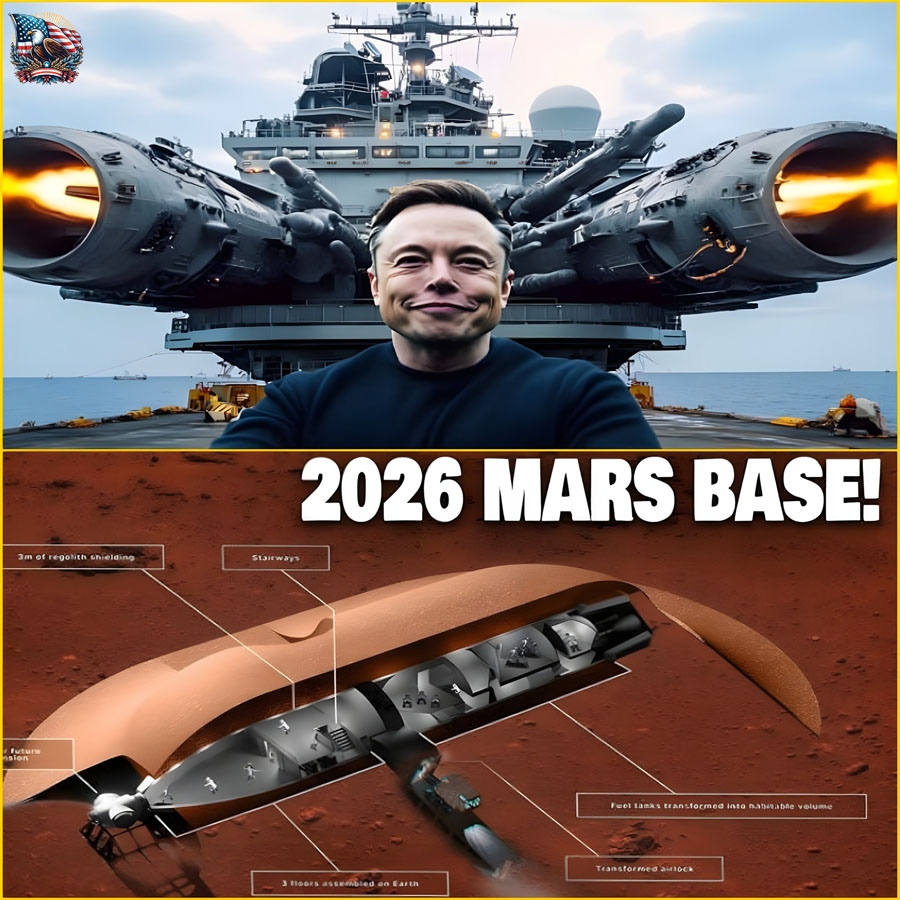
From Impossible to Inevitable
When SpaceX first introduced Starship, critics were relentless. The spacecraft was too big. Too complex. Too risky. Reusable rockets at that scale, they said, bordered on fantasy.
Then came the test flights.
Explosions. Failures. Fireballs lighting up the Texas sky.
And then — progress.
Each launch pushed boundaries. Each failure taught lessons. And with every iteration, Starship edged closer to something no one had ever built before: a fully reusable interplanetary spacecraft capable of carrying humans, cargo, and infrastructure to another planet.
What once looked chaotic now looks deliberate.
According to engineers familiar with the program, the question inside SpaceX has quietly shifted.
It’s no longer “Can Starship reach Mars?”
It’s “How fast can we prepare everything else?”
Why 2026 Suddenly Feels Possible
Mars missions depend on planetary alignment. Roughly every 26 months, Earth and Mars align in a way that allows spacecraft to travel using minimal fuel.
The next optimal window opens in 2026.
Until recently, most experts assumed SpaceX would miss it. Development timelines are notorious for slipping. Human-rated spacecraft take time.
But insiders say Starship’s progress — particularly in propulsion, heat shielding, and rapid reusability — has changed the calculus.
The plan, as described by Musk, wouldn’t involve humans at first.
Instead, the initial missions would be uncrewed, carrying cargo, infrastructure, and life-support experiments. Think power systems. Habitats. Supplies. Robots preparing the ground for future crews.
In other words: not a flag-and-footprints mission — but the first step toward permanence.
“It’s Logistics Now”
That phrase keeps coming up.
Engineers say the hardest physics problems are largely solved. The engines work. The structure holds. Re-entry is improving. Landing is getting closer to routine.
What remains is scale.
Fuel production. Launch cadence. Orbital refueling. Redundancy. Safety margins.
Not dreams — checklists.
And that shift is seismic.
Because logistics can be optimized. Timelines can be compressed. Problems can be solved with money, manpower, and iteration.
Dreams, on the other hand, cannot.
The Risks No One Can Ignore
Of course, skepticism remains — and rightly so.
Mars is unforgiving. Radiation. Dust storms. Extreme cold. Communication delays. A rescue mission would be impossible.
Even an uncrewed mission faces enormous risk. A single failure could erase years of work and billions of dollars.
Critics argue Musk’s timelines are aspirational at best — a tool to motivate teams and attract investment rather than a firm promise.
And history supports caution. Space exploration has humbled humanity before.
But supporters counter with a simple truth:
No one has moved the timeline forward faster than SpaceX.
Why This Time Feels Different
What sets this moment apart isn’t just technology.
It’s momentum.
SpaceX launches more rockets than almost anyone else combined. Reusability has gone from radical to routine. What once took years now takes weeks.
And perhaps most importantly, Starship isn’t being built for a single mission — it’s being built as a system.
A pipeline.
If one Starship fails, another is already on the pad.
That mindset — borrowed from software and applied to space — is what makes 2026 feel less like science fiction and more like a stretch goal with teeth.
What Happens If They Succeed
If a Starship reaches Mars in 2026, even without humans, history will change overnight.
Mars would stop being theoretical.
It would become a destination.
Governments would accelerate their own plans. Funding would surge. The conversation would shift from whether humans should go to who goes next.
And humanity would cross a psychological threshold we’ve never crossed before: becoming a truly multi-planetary species.
The Final Twist
Elon Musk has been wrong before. Timelines have slipped. Predictions have overshot reality.
But he has also been right in ways few believed possible.
Reusable rockets. Private spaceflight. Landing boosters on ships at sea.
Now he’s making his boldest claim yet.
Mars. 2026.
Whether it happens or not, one thing is already clear:
The race to Mars is no longer hypothetical.
The clock is ticking.